Friday, July 25, 2008

Dalijia Peak

Today I drove the highway that traverses the pass just underneath Dalijia Peak (see our website for more info on this mountain). 

Here is a new picture of the peak, which rises to more than 4,500 msnm (14,850 ft.):

Wednesday, July 23, 2008

Xiahe Travel Update: No Good News

As of Thursday, July 23rd, Xiahe and the entire Gannan (Southern Gansu Tibetan Prefecture) region is still officially closed to foreign tourists. This month, many things have actually become more strict, instead of loosening up as we had expected.

For instance, there are now 2 checkpoints on the highway between Linxia and Xiahe that didn't exist at all from March all the way through June.

Just in the last couple weeks, these new checkpoints have been set up to check vehicles entering the region. They are screening primarily for foreigners, journalists, and wanted Tibetans, but many local vehicles are also being forced to register.

These checkpoints are different than any that we saw earlier this year, because they have actually blocked off most of the highway, and cars have to weave in and out of large barriers that have been placed across the road to keep traffic from driving through at full speed.

So I guess the point of all this is to say, "Don't try to visit Xiahe or Langmusi anytime soon!". You won't be able to get here.

Instead, I recommend you take advantage of the travel articles available on this blog, as well as what I have posted on our website (http://www.snowymtncafe.com/).

I will keep posting to this blog at least a couple times per week with new articles and updates, and hopefully one day I will have good news about the opening of this region to foreign tourists!

Thursday, July 17, 2008

Featured Destination: Songmingyan National Forest Park

I am sure you have never heard of Songmiyan National Forest Park, but it is truly a gorgeous place to visit!

Located within Linxia Prefecture (临夏州) in Hezheng County (和政县), Songmingyan (松鸣岩) is a destination that is popular with locals and quite a few tourists from Lanzhou, but very few other outsiders.

There is an entrance fee of about 30 RMB to be paid upon entering the park area, but it is worth the price, especially if you can go on a day with clear blue skies.

You will see large mountains covered in forest, lower hills covered with farms and fields, and a few higher peaks towering off in the distance (Gannan Tibetan Prefecture, which is home to Xiahe and Langmusi, begins on the other side of the larger mountains).

To get there, take a bus from the Linxia South Bus Station (临夏南站) going to the town of Kangle (康乐), and ask to get off at Songmiyan. You can also hire your own taxi for the day from Linxia, or by first taking a bus to the town of Hezheng, and then hiring a taxi from there. It is about 1 1/2 hours by bus (10-15 RMB) to get to the park entrance.

Wednesday, July 16, 2008

Featured Destination: The Geographic Center of China

The vast majority of people do not know where the exact geographical center of China is located, and many people have probably never even thought to ask. The reason why the location is not very well-known is because it happens to be right in the middle of one of the poorest counties in the nation, far from any Chinese-speaking community, in the middle of Dongxiang Minority Autonomous County (东乡族自治县).
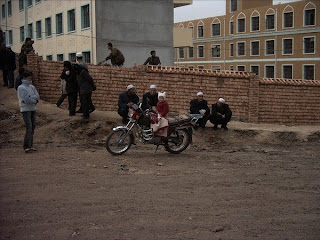
For those of you who have never heard of the Dongxiang people, they are a Muslim minority who speak their own native language at home and in their communities. There are about 500,000 Dongxiang in China, and most of them live in the rugged mountains in and around Dongxiang County, which is part of the larger Linxia Hui Autonomous Prefecture.

Dongxiang County is almost 100% mountainous. The altitude ranges from about 1600 m along the banks of the Yellow River up to 2600 m on the highest peaks. Almost all major roads in the county and the towns with the most people are located on top of the mountain ridges. The ridges are rounded enough for there to be villages and highways, but the valleys are often too narrow and steep for either houses or any kind of road. So it is an interesting place to visit!

To get to Suonanba (锁南坝), the largest town and commercial center of Dongxiang County, simply take a bus from the Lanzhou South Bus Station (兰州汽车南站).The drive is spectacular at times, as the road follows the top of the ridge all the way to town, and the trip should take 2-3 hours (20 RMB).

To get from Suonanba to the Geographic Center of China, you will need to hire a local taxi or private car (there are many around) to take you to the village of Dongling (董岭), located about 30 km north of Suonanba on top of a high mountain ridge (you will be driving on top of the mountains the entire time!). When you arrive in Dongling, it will be easy to see the odd-shaped tower sitting on top of the mountain just a short walk away. That's the marker for the Center of China.

Another way to return to Lanzhou (or to come to Dongxiang) is through the city of Liujiaxia (刘家峡), which is the starting point for trips to the Buddhist grottoes of Bingling Si (see your Lonely Planet). There are a few buses every day (very few!) from Suonanba to Liujiaxia and the trip covers about 60 km and takes 2-3 hours. From Liujiaxia it would be possible to hire a taxi to take you up to Dongling (30 km) and on to Suonanba.

Here are some more pictures from around Dongxiang County:

Sunday, July 13, 2008

New Police Checkpoint

On Friday afternoon, we were stopped for 3 hours while we were driving back from Linxia to Xiahe. This new checkpoint is located right at the place where Linxia and Xiahe meet, along the main highway.

Here's the story as I wrote it for my family back home in the States:

We had been gone for 2 days visiting a good friend in a town about 100 kilometers away from where we live in Xiahe. Today at 2:30 pm we managed to head out of town on our way home. It is about a 1 hr 20 minute drive under normal conditions.

At 3 p.m. we were stopped at a police checkpoint located right at the border where our prefecture meets the prefecture that we had been visiting for 2 days. Checkpoints have become a way of life since the Tib-et-an riots that happened back in mid-March, so this was nothing new. However, this was the first time since March that there had been a checkpoint at this location. Most of the time we were able to drive straight through on home without being stopped at all.

I was first asked by the police (and the military guards standing with him), "where are you going?". I replied that my family and I were "Going home". I then explained that we lived in this prefecture and that we were allowed to be there, even though other outsiders are currently banned from entering.

They seemed content with my answers and all seemed well, until we were told that we would need to wait for approval from "up above". They were not referring to a messenger from heaven, but from a particular office in the police department. They had made a phone call and were now waiting for a response saying that yes, we could continue on our journey. And thus began our afternoon sitting on the side of the highway, with my 2 1/2 year old boy, 15 month daughter, and 5 month pregnant wife, and the testing of my patience.

You have to understand that I could have done these guys' jobs better than they can. I know how their local government works better than they do, and I knew that we had permission to do what we were doing, even if they didn't. They kept referring to local government bureaus that really don't even exist, and how these people had to approve for us to travel on home. They were doing all they knew how to do, but therein lay the problem. They didn't know too much!

So we waited, and waited, and waited some more. My kids played in the gravel, chased chickens at a nearby homestead, tried to eat some of the gravel, screamed a bit, ate some peaches, chased chickens a bit more ... for 3 full hours, from 3 pm all the way until 6 pm.

Finally, after I made numerous phone calls to people in the local government who I thought DID know how things were supposed to work, the necessary approval arrived and we were 'free to go'. And just in time! We were just getting the kids washed up to get ready to head back down the highway to get some dinner at the last restaurant we had passed.

It was another hour or so to get home, which made the total trip time right at about 5 hours... to travel 100 kilometers! I hope that we don't have to go through that again... especially for something so harmless as trying to get home to put the kids in bed!

(I don't recommend trying to visit Xiahe right now, either from Linxia or from Tongren. There are very strict checkpoints with police and military on both routes. It looks like it is going to be very tight here until after the Olympics are over, at least.)

Tuesday, July 8, 2008

Featured Destination: Tianzhu (天祝)

It is likely than you have never even heard of Tianzhu Tibetan Autonomous County (天祝藏族自治县), located to the northwest of Lanzhou.

Although Tianzhu is home to quite a few Tibetans, most of these have lost much of their cultural identity and traditional language and dress. In other words, they are Tibetan by virtue of their heritage. This is about the only downside to visiting their region!

Although relatively close to Lanzhou, and not in a direction that one typically thinks of being a Tibetan area, Tianzhu and its surrounding landscapes are suprisingly very much like what you see in the Xiahe region.

There are many big mountains, with the highest peaks reaching 4,000 msnm, that make up the very southern part of the Qilian Mountain range that straddles the Gansu-Qinghai border for more than 1,000 km.

Tianzhu is also home to a very large number of white yaks. It is known as the home of the Tibetan White Yak. These are not hard to spot as you travel the roads that cross the county.

When I visited Tianzhu, during the last half of May, I was amazed by the coolness of the air, the beauty of the mountain rivers and lakes, and the ruggedness of the mountains.

I was never able to visit the town called Heaven ("Tiantang" in Chinese) located at the opposite end of the county, but I hear it is beautiful, nestled along the banks of the Datong River. Tiantang is home to a fairly large monastery with visiting monks from places as far away as Labrang and elsewhere.

You can get to Tianzhu by taking a bus from Lanzhou (2-3 hours, 20-30 RMB). Try the Main Station, located near the Train Station, or possibly the West Bus Station.

Once you arrive, you will need to hire a private taxi to take you into the more rural regions of the county and to the town of Heaven.

Saturday, July 5, 2008

More Checkpoints, Less Freedom

In my last post, I mentioned that it shouldn't be too difficult to get to Xiahe, even though it is still officially closed to tourism by foreigners.

Well, that is no longer the case. Within the last week, a new checkpoint has been set up on the highway between Linxia/Lanzhou and Xiahe and you will most likely be sent back to Linxia or Lanzhou if you try to take a bus to Xiahe on that route.

There are also more military and police patrolling the streets in Xiahe than there have been for the last month or so. I am not sure why the increase, but probably just as an extra 'precaution' before the Olympics begin in the next month or so.

If you want to travel in this region and see Tibetan culture, please consider visiting Qinghai Province. I have heard that there are almost no restrictions whatsoever on travel to the Tibetan areas of Qinghai.

For some articles and recommended places to visit in Qinghai, see my articles on Yushu, Nangqen, and Daowei posted on our website: http://www.snowymtncafe.com/

Business is non-existant for us. We were hoping to be back open by now, but so far no luck.

In the meantime, I'll keep this blog updated, hopefully with some new travel articles very soon.

Cheers,

Eugene

(the pics in this post were taken near Nangqen, in Qinghai Province)

Tuesday, July 1, 2008

Xiahe/Langmusi: Still No News

I just saw our local PSB friends this morning, and they said that they have still not recieved any news about a change in the situation here. So for now (as of July 1st) foreign tourists are still not welcome in this region.

I would say, however, that there are very few checkpoints on the highways and that if you were happy to just make a day trip to Xiahe, you shouldn't have any problems. Your "day trip" might be shortened by a few hours, depending on when and if the local PSB friends of ours find you, but you should have time to at least see the place!

That's about as best you have to look forward to for now!

More news when things change....

Friday, June 27, 2008

Visa Renewal Adventure

The time has come for our family's yearly visa renewal here with the local police.

Visa renewal is almost always a hassle in this culture. It seems that you never come to the place where the people know you and you know them and there are no crazy questions or petitions. This year is even worse as a result of the earthquake and other situations that have taken place already this year.

Every year we are required to present (sometimes for the 3rd, 4th, or 5th time) government issued health exams, business licenses, employment permit, tax registration, commercial approval certificates, all up to date and in order, or else you can't apply for your visa renewal.

This may sound reasonable, but you often run into hurdles. For instance, today I called the lady in charge of issuing our visas. Her office is in a city about 40 miles away (1 hr). I wanted to know if she would be in the office today because I had been in there both yesterday and the day before but she wasn't there either day! Our visas expire on July 1st (Tuesday) and today is Friday. They don't work weekends.

So I call her and ask if she will be in the office today. She says yes, and quickly runs through the list of things that we would need to bring, including one document called an "employee permit". I told her that my employee permit also expires on July 1st and it is currently in the process of being renewed. She said, "Well, you've got to have that or we can't give you a visa. Don't come until you have it." I said, "My visa expires really soon. And that document is in the hands of government officials. There is not much I can do." She replied in so many words, "Well, that's too bad. You can't get your visa until you bring me that document."

Thankfully, when I called the guy about my "employee permit" he said that it was done and in the mail. So I should have it by tomorrow (Saturday) or Monday at the latest, just in time to apply for our visa renewal before Tuesday. But under normal (sane) circumstances, we would have applied for the visas on Wednesday (2 days ago).

Thursday, June 26, 2008

Education among Amdo Tibetans

Below I have posted the notes that I took this afternoon as a Tibetan friend of mine dictated to me the situation of education among his people, especially those from more rural areas.

This friend and I are planning to do what we can to raise support for numerous Tibetan young people who will not otherwise be able to attend school for more than 2 or 3 years. If you are interested in donating to help send poor, rural Tibetan kids to school, please shoot me an e-mail anytime or look for the Donate link posted on our website or on this blog.

The Education Situation Among Many Tibetans in China

In the past, Tibetans were typically a people who stayed to themselves, and education was traditionally reserved only for religious students and future leaders of society.

Today, in the modern Chinese world, any Tibetan has the right and opportunity to get an education. In regions that are officially self-governed by the Tibetan people, students are allowed to study the Tibetan culture and language, but its general use is fairly small. Tibetan is not used in any official government work.

Tibetan students these days begin to learn both Tibetan and Chinese from a very young age, almost at the same time. However, the level of education and Chinese that these students learn is very poor compared to Han Chinese regions.

Of those students who major in Tibetan studies at university, only about 30% are able to find work as teachers, and even those are only permitted (or have opportunity) to teach Tibetan within their own Tibetan autonomous prefectures. If these students were to try to find work in another Chinese company or in the government, usually their level of Chinese (although possibly good) is not up-to-par with normal Chinese students who vie for the same jobs. And Tibetan is either not permitted, or is not normally used in most Chinese companies and in all government posts.

The Tibetan students described in these past few paragraphs almost always come from the county seats of their region; or, in other words, the areas with more money and influence.
In rural areas, many children only study for a year or two before their parents pull them out of school to go and have them help with work around the family ranch. Usually these kids start going at 9 or 10 years of age, and are primarily sent by their parents to learn a bit of Tibetan so that they can then be able to read and recite some of the basic Tibetan Buddhist scriptures. Kids and teenagers are often punished by their parents and/or neighbors for not being able to read and recite at least basic Tibetan Buddhist scriptures.

After the parents feel that the kids have learned enough, they are taken out of school to go work with their families, mostly tending sheep and yaks up in the mountains. They are often married off as teenagers and begin to have kids and families of their own. The cycle then repeats itself.
The parents are stuck between a rock and a hard place. They need money to send the kids to school, but they need the kids to work on the ranch to make any money.

Although the Chinese government mandates that all students, including Tibetans, complete at least 9 years of studies, 70-80% of rural Tibetan young people never reach that goal, and many do not finish more than just 2-3 years of studies.

So there are many, many Tibetans who can’t read any Chinese whatsoever. In a large Chinese city, they are unable to even find, either by reading the signs or asking directions, a public bathroom. They are completely Chinese illiterate.

I was told the story today of a Tibetan man who, unable to locate a public bathroom in a certain Chinese city, squatted down on the side of the road to do his 'business' just as he would have done up in the mountains. When a police officer approached to ask what he was doing, he covered what he had done with his hat and tried to tell the officer that it was a bird that he had trapped underneath (he did this by waving his arms and making bird noises, because remember, he didn't speak any Chinese). When the officer finally managed to pick up the hat and saw what was really hidden there, the poor Tibetan was promptly arrested.